Do you find peace, beauty and belonging in Nature? Under a clear night sky filled with stars and galaxies do you feel a profound sense of awe and wonder? Then you may find Scientific Pantheism congenial. Your support enables us to post and boost powerful messages and memes focused on saving the Earth and Life rather than ‘saving’ souls that don’t need saving. We promote respect for the rights of humans and all sentient beings. Our posts reach tens of thousands of people at very low cost. We are totally naturalistic and non-theistic, and value the evidence of our own senses and sciences over adherence to ancient scriptures.
Why Scientific Pantheism might match you
Our messages and memes relate closely to the central challenges of our era. At a time when the balance of our Earth is under unprecedented threat, scientific pantheism is a form of spirituality in which Nature plays an absolutely central part, free of literal spirits or gods. For us, Nature is a direct source of peace, solace, joy and beauty, as well as the focus for our gratitude, love, care and vigilance. We emerged from Nature and remain an inseparable part of Nature. We have a calling to live sustainably, to care for Nature and to halt and reverse the harm that humans have done to Nature through our greed and waste.
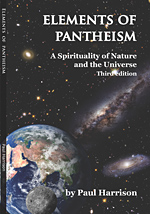
Paul Harrison’ classic book on Pantheism
history, theory, and practice
Scientific pantheism is the only form of spirituality we know of which fully embraces science as part of the human research and exploration of Earth and Cosmos. We wonder at the picture of a vast, creative and often violent Universe revealed by the Hubble and James Webb Telescopes. We regard stargazing as a spiritual practice. We oppose climate change denial and evolution denial and denial of history. We are shocked to the core that earth-pointing satellites are turned off. Agencies monitoring lands, oceans, weather and environment are being closed and staff axed to conceal the damage that greed and ignorant policies are doing and Nature is suffering.
Scientific pantheism encourages a joyous affirmative approach to life. It has a healthy and positive attitude to sex and life in the body. We won’t tell you what you should be smoking or doing in the bedroom. We fully accept gender and sexual diversity, and we oppose all forms of discrimination.
Scientific pantheism moves beyond “God” and defines itself by positives. Atheism and Agnosticism both define themselves negatively, in relation to a “God” that they both deny or doubt. These are useful starting points – but they don’t take us far. Most people also need positive beliefs and feelings about their place in Nature and the wider Universe. Scientific pantheists take Nature and the Cosmos as our start and finish point, not some preconceived idea of “God.” We do not believe in a supernatural creator god who watches or judges us. Most scientific pantheists avoid god-language or religious words like church, worship, divinity and so on. We regard them as misleading in relation to pantheism. Those of us who do like to use these words, use them metaphorically, as a way of expressing their deep feelings of reverence, gratitude and belonging towards Nature and the wider Universe.
The basic principles
Our beliefs and values are summarized in our Principles of Scientific Pantheism. The statement was drawn up by fallible humans. It is not required dogma – it is simply a notice on our door, to show what we are about so people can decide if it suits them or if they want to learn more. These are the key elements:
- Reverence, awe, wonder and a feeling of belonging to Nature and the wider Universe.
- Celebration of our lives in our bodies on this beautiful earth as a joy and a privilege.
- Respect and active care for the rights of all humans and other living beings.
- Promotion of non-discrimination, religious tolerance, freedom of and from religion and complete separation of state and religion.
- Realism – belief in a real external world that exists independent of human consciousness.
- Strong naturalism – without belief in supernatural realms, afterlives, beings or forces.
- Respect for reason, evidence and the scientific method as our best ways of understanding nature and the Cosmos.
Spiritual but not religious
Many people feel the need to belong to a religious community. Research shows that such groups provide mutual support and friends and are good for physical and mental health. Groups of like-minded non-theistic folk can enjoy similar benefits.
In the WPM we are spiritual but not religious. By spiritual we don’t mean spiritualistic. We are not talking about a spirit or soul separate from our body. We mean that whole complex of deep feelings, values and beliefs that inspire our core sense of place in human society, Nature and Universe.
We don’t have churches, priests, or prescribed dogma and rituals. But we do aim to provide a “home base” for people who have deep feelings for Nature and the Universe and who do not believe in supernatural entities.
Our members and friends gain new like-minded friends and find a place where they can share their enthusiasms without fear of being ostracized or feeling isolated. There have been many local meetings of members across the USA and in other parts of the world, where people have found a rare level of fellowship and stimulation.

The WPM’s short term goals are to:
- Promote the values of environmental concern and human and animal rights.
- Make earth-honoring life-affirming naturalistic beliefs widely available as a rational alternative to supernatural and theistic religions.
- Promote forums for these beliefs and values on various Internet channels and other media.
- Encourage local gatherings by providing fora for networking.
- Support separation of church and state and freedom of religion (including non-religion).
In the longer term, as resources permit, we hope to:
- Promote the formation of longer-lasting local and interest-based groups
- Create a network of civil celebrants for Nature and life-oriented child dedications, weddings, and funerals. Subscribing members can get certification on request, to be a celebrant for family and friends.
- Sponsor Nature conservation activities and help members to conserve Nature
- Actively address other issues such as women’s rights, animal rights, science education including evolution and climate change, drug laws, dark skies, and more.
If you would like to help promote these goals, please consider becoming a WPM member. Volunteering is another great way of supporting the WPM.
All who agree with our principles are encouraged to like our Facebook page (with 160,000 fans), or join our Facebook discussion group with 15,000 members.
Closely allied beliefs
We use the name pantheism because the term encompasses a long and venerable history dating back to Heraclitus and Marcus Aurelius and extending to Einstein, D. H. Lawrence and beyond.
Our beliefs (see the Statement of Principles) are entirely compatible with atheism, humanism, agnosticism, and symbolic paganism (viewing magic, gods and spirits as symbols rather than objective realities). We offer a home to all forms of naturalistic spirituality however you may choose to label it. Other paths that approximate include philosophical Taoism, modern Stoicism, Western forms of Buddhism that celebrate Nature and daily life without supernatural beliefs, and Unitarian Universalists who do not believe in supernatural beings.
You are free to adopt the terms and practices you prefer and draw on other traditions for inspiration or celebration. Some call this a religion (a positive one), while others call it a philosophy, a way of life, or a form of general spirituality. It’s up to you.
Please explore our pages. If you have any questions, please contact us